
The most famous board game of all time, MONOPOLY, is traditionally a game that has a history of going on for hours and a game that is entirely known to be played with strategy and a decent bit of luck, but what if I told you there was another factor? MATH!
To start, lets breakdown 2 crucial details that will elegantly lead to a nice ranking of which color sets to aim for:
1. Many would think that every MONOPOLY spot has an equal probability of landing on, but the reality is quite the opposite. The most landed on square is the notorious JAIL square. Let’s break this down:
a.There is the self explanatory Just Visiting spot, this has the same probability as moving to any ordinary square.
b.Then diagonally across the board we have the GO TO JAIL space, like before the same probability as any ordinary square
c.Lastly there are also one chance and community chest card each titling GO DIRECTLY TO JAIL each with a 1/16 probability of drawing from their respective decks
As you can see the JAIL square is superior(in terms of landing probability) to any other spot on the board, in fact this entire post centers around this very concept!
2.The second detail all has to do with how the game is played, DICE! Well a normal dice rolls on any number evenly with each number a probability of 1/6 but like in MONOPOLY when there are two dice your expected value for each roll is a 7. In fact you have a 1/6 chance in doing so(this is calculated by 6 pairs making 7 and the total 36 number of outputs)!
Now based on these two details let’s pair up frequency and price to get a overall ranking of the colorsets!
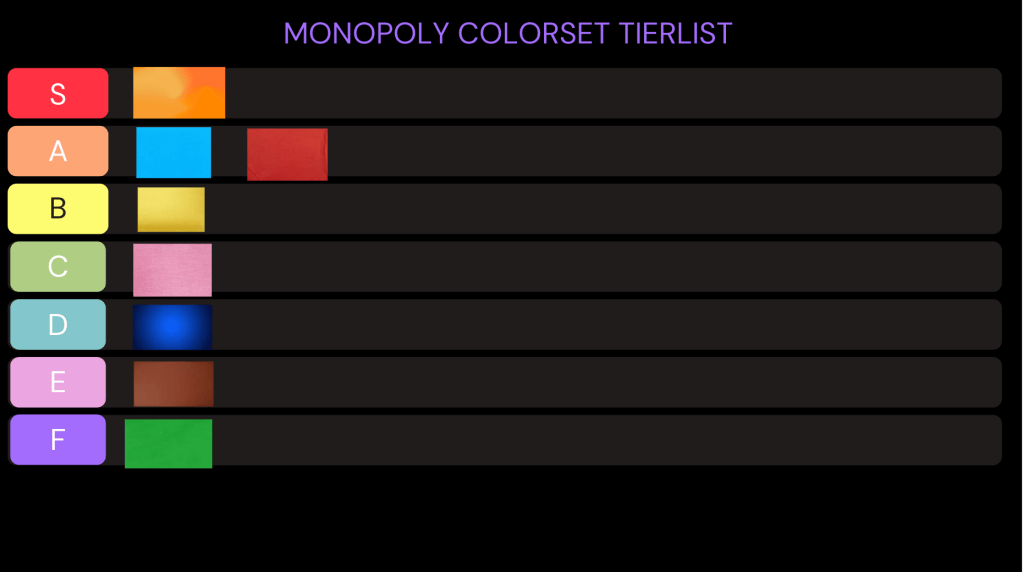
EXPLANATION:
(S)Orange: The colorset is clustered 6,8,and 9 spots away from the most visited spot jail, so from jail you have a 7/18 chance of hitting the orange set, it is also worth the same as the pink per house but has a much higher landing probability!
(A)Light Blue: This colorset is severely undervalued! Its very easy to grab yourself hotels and is clustered 6,8,and 9 away from a common spot on the board GO!
(A)Red:Expensive,but worth it. Around two moves away from jail as well as having cards like ADVANCE TO ILLINOIS AVENUE.
(B)Yellow:Same price as red and in a nice spot on the board!
(C)Pink:Two moves from GO, near jail as well!
(D)Dark Blue: A super-pricey colorset with only two squares, high risk, high reward!
(E)Brown: Completely irrelevant unless you stack houses/hotels, only two spots!
(F)Green:This is statistically the worst colorset, houses are priced the same as Dark Blue, and there is also the GO TO JAIL square that can suck up traffic.
Now this is all a general ranking depending on the game situation this ranking will obviously change, sometimes the Green colorset may win you the game, or the Orange will loose you the game, but in terms of math and probability these rankings are pretty accurate!
So next time you’re playing MONOPOLY follow these general rankings to boost your odds at a victory, and leave the people you play with in shock!

